There is a part of India that most Indian families have never seen. A part so lush, so dramatically beautiful, so deeply original in its cultures and landscapes, that first-time visitors often simply stop talking — overwhelmed into a silence that is entirely different from the noise they left behind at home. This is India's Northeast — the Seven Sisters — and it is, without question, the most rewarding family road trip this country can offer.
Tucked between Bhutan, Tibet, Myanmar, and Bangladesh, the northeastern states feel like they belong to a different world. The rivers are wider, the forests are denser, the silences are deeper, and the people — from the Khasi of Meghalaya to the Adi of Arunachal to the Naga of Nagaland — carry a cultural richness and a warmth toward visitors that is genuinely extraordinary. Travelling here with your family does not just show your children a different part of India. It shows them a different way of understanding what India is.
At EZIO Travel, we have been curating Northeast India journeys for families for years, and we never tire of watching what this region does to people who arrive for the first time. Something shifts. Something permanent. This guide is our most comprehensive roadmap to the Northeast — the places, the experiences, the practical essentials, and the hidden gems that most tour operators never mention.
The Northeast is not India's edge. It is India's heart — fierce, green, deeply alive, and waiting for the families brave enough to discover it.
STATE 01
Meghalaya
Abode of Clouds
STATE 02
Assam
Tea & Tigers
STATE 03
Sikkim
Mountain Magic
STATE 04
Arunachal
Dawn-Lit Peaks
STATE 05
Nagaland
Warrior Culture
STATE 06
Manipur
Jewel of India
STATE 07
Mizoram
Blue Mountain
Why Northeast India is the perfect family road-trip destination
Before we dive into the individual states, it is worth pausing to understand why the Northeast works so magnificently for families specifically — because it offers things that no other region in India can match.
First: it is genuinely safe. The Northeast's reputation for complexity is decades out of date. The major tourist destinations across all seven states are welcoming, well-developed for visitors, and among the most hospitable environments in the country. Second: it is uncrowded. While Rajasthan and Goa heave with tourists during peak season, the Northeast remains blissfully, gloriously undiscovered by the mainstream Indian travel market. Third — and most importantly for families — it is educational in the deepest sense. Children who travel through the Northeast return with an understanding of India's biodiversity, cultural plurality, and geographical drama that no school curriculum can provide.
The road journeys themselves are extraordinary. Winding mountain roads through cloud forests, river crossings on bamboo bridges, descents into valleys so green they seem to glow — driving through the Northeast is not a means to a destination. It is the destination.
EZIO NORTHEAST TRAVEL NOTE
Several Northeast states require permits for non-residents: Arunachal Pradesh requires an Inner Line Permit (ILP) for all Indian citizens, and Nagaland, Manipur, and Mizoram also require ILPs. Foreign nationals need Protected Area Permits for Arunachal and Sikkim. EZIO manages all permit applications as part of every Northeast family package — we handle the paperwork entirely so you can focus on the journey.
Meghalaya — the Abode of Clouds where nature made its masterpiece
Meghalaya
THE WETTEST, GREENEST, MOST EXTRAORDINARY STATE IN INDIA
Recommended: 4–5 days
Meghalaya receives more rainfall than almost anywhere on Earth — Mawsynram, a village in the East Khasi Hills, holds the record as the world's wettest place — and the result is a landscape of almost supernatural lushness. Waterfalls cascade from every hillside. Rivers run clear as glass over beds of smooth stone. The forests are so dense and so green that they seem to produce their own light.
But Meghalaya's greatest wonder is not its rainfall. It is what the Khasi people have done with it over centuries. The Living Root Bridges of Cherrapunji and Nongriat — grown from the aerial roots of rubber trees, trained across streams and gorges over generations until the roots fuse into load-bearing bridges strong enough to carry fifty people — are among the most extraordinary human-natural creations on the planet. Children who cross these bridges, understanding that it took 15 to 30 years to grow a single crossing, never see the relationship between humans and nature the same way again.
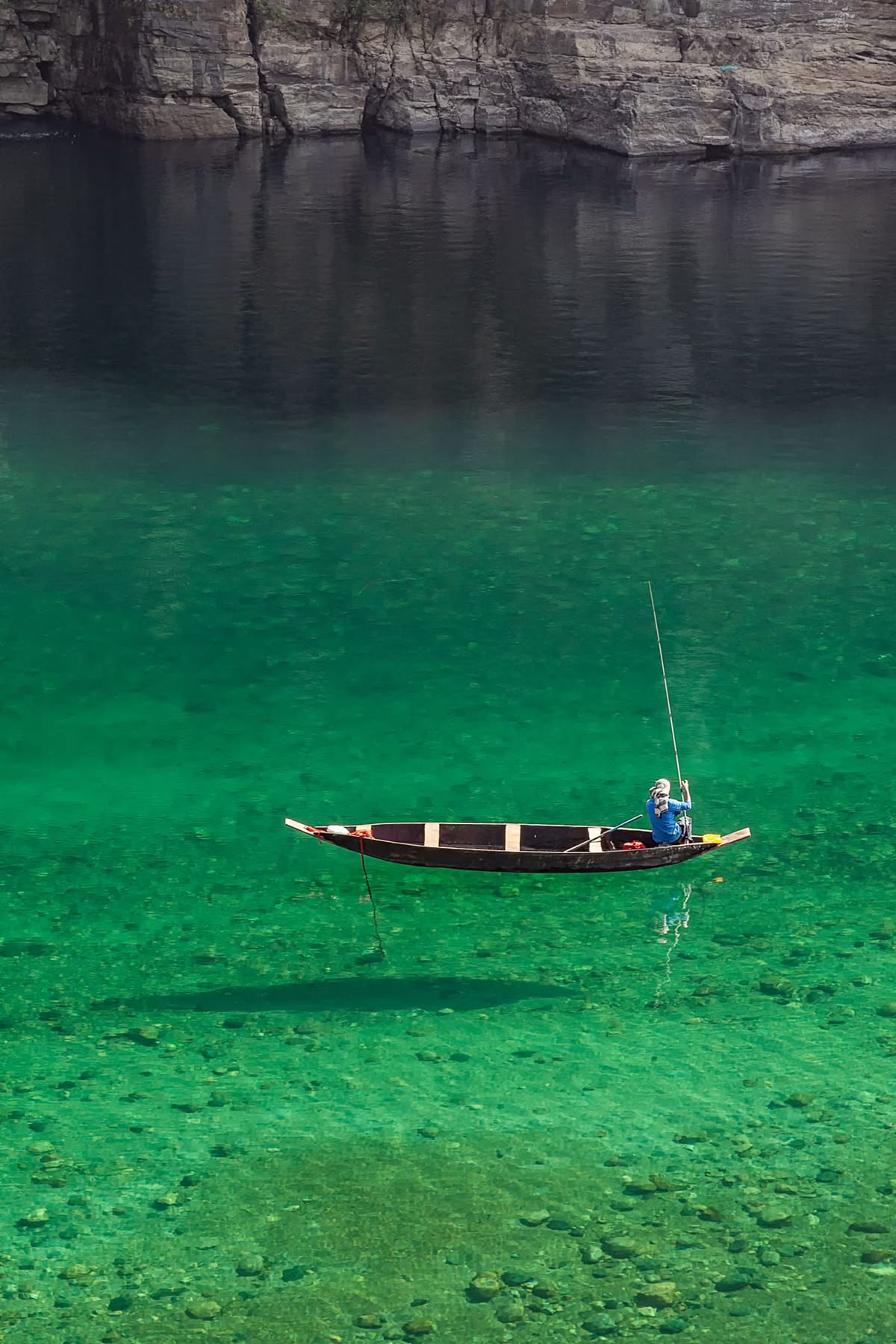
Shillong, the state capital, is the cleanest and most culturally vibrant hill station in Northeast India — a city of music (Meghalaya produces more rock bands per capita than anywhere in India), Scottish-colonial architecture, and the extraordinary Wards Lake. Dawki, on the Bangladesh border, has the Umngot River — where boat rides reveal the river bed through water of such exceptional clarity that boats appear to float in air.
HIDDEN GEM
Double Decker Root Bridge
Two living root bridges stacked vertically. The 3,500-step trek from Nongriat is challenging and completely worth it.
FAMILY FAVOURITE
Mawlynnong Village
Asia's cleanest village. Community-maintained bamboo dustbins, sky-walk over the treetops, and extraordinary warmth.
UNMISSABLE
Dawki — Umngot River
Crystal-clear river where boats appear to float on air. Best visited early morning before the tourist boats crowd in.
FOR ADVENTURERS
Krang Suri Waterfall
A turquoise waterfall pool in a forested gorge — one of the most beautiful swimming spots in all of India.
CULTURAL
Shillong Music Scene
Live rock and folk performances every evening in Shillong's Police Bazaar. India's unlikely music capital.
OFFBEAT
Laitlum Canyons
Dramatic canyon views near Shillong that few visitors discover. Arrive at sunrise for extraordinary light.
EZIO TIP — MEGHALAYA FAMILY PLANNING
The Double Decker Root Bridge trek involves approximately 3,500 steps down and back up. It is achievable for children aged 10+ with moderate fitness, but plan for 4–5 hours and carry ample water. EZIO arranges porters for families with younger children or senior members. Stay overnight in Nongriat village homestays for the full experience — these village homestays, arranged by EZIO, are among the most authentic accommodation experiences in Northeast India.
Assam — where one-horned rhinos roam and tea perfumes the air
Assam
GATEWAY TO THE NORTHEAST — TEA, TIGERS & THE MIGHTY BRAHMAPUTRA
Recommended: 3–4 days
Assam is the Northeast's threshold — the state that welcomes you into the region's world through a gateway of tea gardens, river islands, and one of the most significant wildlife reserves in Asia. Most families enter the Northeast through Guwahati, Assam's capital, and what greets them immediately is the sheer scale of the Brahmaputra — one of Asia's great rivers, nearly 15 kilometres wide in places, its islands housing the only river island inhabited by rhinoceroses in the world.
Kaziranga National Park is the centrepiece of any Assam family itinerary and one of the greatest wildlife experiences India offers. Home to over two-thirds of the world's remaining one-horned rhinoceroses — approximately 2,600 animals — Kaziranga is a UNESCO World Heritage Site whose morning jeep safaris through tall elephant grass, with rhinos grazing serenely in every direction, create an encounter with the natural world of extraordinary intimacy and power. Tigers, elephants, wild water buffalo, and over 480 species of birds complete the wildlife picture.
The tea estates of the Brahmaputra valley — spreading across hundreds of kilometres of emerald green — offer plantation stays where families can walk through the gardens learning how tea moves from bud to cup, and where the bungalows of the original colonial planters, now converted to heritage accommodation, provide some of the most atmospheric stays in the Northeast.
WILDLIFE
Kaziranga — Jeep Safari
Dawn safari in the central range. Rhinos at 10 metres. Nothing prepares you for the scale of this encounter.
UNIQUE TO EARTH
Majuli River Island
World's largest river island. Neo-Vaishnavite monasteries, mask-making traditions, and extraordinary river life.
HIDDEN GEM
Pobitora Wildlife Sanctuary
Highest density of one-horned rhinos in the world. Less visited than Kaziranga — more intimate sightings.
CULTURAL
Sivasagar — Ahom Kingdom
Ancient capital of the Ahom kingdom. Temples, tanks, and palaces that ruled for 600 unbroken years.
Sikkim — where the Himalayas meet Buddhist serenity
Sikkim
INDIA'S MOST SERENE STATE — MONASTERIES, MOUNTAINS & MAGIC
Recommended: 4–5 days
Sikkim is India's smallest state and, many travellers would argue, its most beautiful. Dominated by Kanchenjunga — the world's third-highest peak at 8,586 metres — Sikkim blends Tibetan Buddhist culture with Himalayan landscapes and a biodiversity so extraordinary that the state has been entirely organic in its agriculture since 2016, a distinction no other Indian state can claim.
Gangtok, the capital, is a remarkably vibrant hill city. The MG Marg pedestrian precinct — lined with cafes, handicraft shops, and bakeries serving the most extraordinary momos — is one of the most genuinely pleasant urban walking experiences in the Himalayas. The Namgyal Institute of Tibetology houses one of the world's finest collections of Tibetan Buddhist manuscripts and thangkas. The ropeway connecting Gangtok's ridge gives families a bird's-eye view of the Himalayan horizon that produces uniform, unqualified gasps.
Beyond Gangtok, the state reveals its deeper magic. Tsomgo Lake — a glacial lake at 3,753 metres, surrounded by peaks that hold snow through most of the year — is accessible by road and offers a high-altitude experience without the acclimatisation demands of Ladakh. Rumtek Monastery, one of the most important Buddhist monasteries outside Tibet, carries a spiritual gravity that is felt by visitors of every faith. And North Sikkim, requiring a special permit even for Indian citizens, offers some of the most dramatic and least-visited Himalayan landscapes in the entire country.
UNMISSABLE
Tsomgo Lake
Glacial lake at 3,753m — stunning year-round. Yak rides for children around the frozen lake in winter.
SPIRITUAL
Rumtek Monastery
One of Buddhism's most sacred sites outside Tibet. The prayer hall's murals and thangkas are extraordinary.
HIDDEN GEM
Ravangla — Buddha Park
130-foot Sakyamuni Buddha statue with panoramic Himalayan views. Completely overlooked by mainstream tourists.
FOR FAMILIES
Pelling — Kangchenjunga View
The clearest views of Kanchenjunga in all of Sikkim. Sunrise from the hotel rooftop is incomparable.
EZIO TIP — SIKKIM ACCLIMATISATION
Gangtok sits at approximately 1,650 metres — comfortable for all ages. Tsomgo Lake at 3,753 metres requires one full acclimatisation day in Gangtok before visiting. North Sikkim (Lachen, Lachung, Gurudongmar Lake at 5,183m) requires 2–3 acclimatisation days and is suitable for healthy adults and teenagers but not recommended for young children or seniors with cardiac conditions. EZIO's medical advisory for Northeast India families covers all altitude considerations in detail.
Arunachal Pradesh — the last great Himalayan frontier
Arunachal Pradesh
LAND OF THE DAWN-LIT MOUNTAINS — INDIA'S FINAL FRONTIER
Recommended: 5–6 days
Arunachal Pradesh is India's largest northeastern state and its most dramatic. Stretching from the Brahmaputra plains in the south to the high Himalayan ranges bordering Tibet in the north, it encompasses a vertical range of nearly 7,000 metres and contains more than 26 major indigenous tribes, each with their own language, traditions, and relationship with an extraordinarily demanding landscape.
Tawang — the birthplace of the sixth Dalai Lama and home to the Tawang Monastery, the largest Buddhist monastery in India — is the jewel of Arunachal Pradesh and one of the most magnificent destinations in the entire country. Sitting at 3,048 metres in a high valley surrounded by snow peaks and prayer flags, Tawang has a quality of sacred stillness that is difficult to find anywhere else. The monastery itself — a 400-year-old complex of prayer halls, monk quarters, and butter lamp shrines — is a living, breathing centre of Tibetan Buddhism whose morning prayers, attended by hundreds of maroon-robed monks, are among the most moving experiences a family can share.
The approach to Tawang through the Sela Pass at 4,170 metres — where the road climbs through cloud and emerges into a world of high-altitude wetlands, frozen lakes, and peaks that seem close enough to touch — is, in itself, one of the great road journeys of India. When the pass is snow-covered (October to March), the drive is simply unforgettable.
UNMISSABLE
Tawang Monastery
India's largest Buddhist monastery. Dawn prayers with hundreds of monks — a profoundly moving family experience.
ROAD DRAMA
Sela Pass (4,170m)
One of India's most spectacular mountain roads. The pass lake — Sela Lake — is frozen and ethereal in winter.
HIDDEN GEM
Ziro Valley
UNESCO-nominated valley of the Apatani tribe. Terraced rice fields, pine forests, and extraordinary tribal culture.
ADVENTURE
Namdapha National Park
India's third-largest national park. Four big cat species, including the snow leopard. Extraordinary biodiversity.
CULTURAL
Along — Galo Tribe
The Galo people's villages along the Siang River offer authentic homestay experiences of rare warmth.
SCENIC
Dirang Valley
Apple orchards, hot springs, and the ancient Dirang Dzong fort — a gentle pre-Tawang acclimatisation stop.
Nagaland — where warrior culture meets extraordinary hospitality
Nagaland is the Northeast's most culturally unique state — home to 16 major Naga tribes, each with distinct traditions, weaving patterns, and warrior histories that are alive not in museums but in the everyday life of its communities. The state capital Kohima, site of one of the Second World War's most decisive battles, carries a profound historical weight alongside its extraordinary natural beauty.
The Hornbill Festival — held every December at Kisama Heritage Village near Kohima — is the greatest cultural celebration in the Northeast and one of the most extraordinary events in India. Ten days of tribal dance, music, traditional games, and warrior ceremonies from all 16 Naga tribes, gathered in one place. For families who can time their visit, this is a genuinely unmissable experience that children carry with them for life.
Beyond the Hornbill, Nagaland rewards slower exploration. The Dzükou Valley — a high-altitude valley on the Nagaland-Manipur border, carpeted with flowers in spring and accessible by a half-day trek — is among the most beautiful landscapes in the Northeast. The village of Khonoma, India's first green village, is a model of sustainable community living that produces one of the Northeast's most thought-provoking family experiences.
Manipur & Mizoram — the jewels the road less travelled reveals
Manipur — the Jewel of India — is a state of extraordinary visual beauty centred on Loktak Lake, the largest freshwater lake in Northeast India and home to the world's only floating national park, where circular islands of vegetation called phumdis drift slowly across the lake surface, inhabited by the endangered Sangai deer. Imphal's Ima Keithel (Mother's Market) — the world's largest all-women market, run exclusively by mothers for centuries — is one of the most remarkable civic and cultural institutions in Asia.
Mizoram — the Blue Mountain state — is the least-visited of the Seven Sisters and arguably the most visually consistent: a state of rolling blue-green hills, bamboo forests, and immaculately clean Presbyterian villages perched on ridgelines with views that extend for a hundred kilometres on clear days. Aizawl, the capital, is a city that climbs its ridgeline so steeply that houses are built on stilts, and the streets offer panoramic valley views from every level. The Phawngpui National Park, home to the Blue Mountain (Phawngpui peak at 2,157m), is a trek of extraordinary beauty through forests of rhododendron.
Each northeastern state is a separate country of the imagination — a distinct language, a distinct landscape, a distinct way of being human. To travel through all seven with your family is to read the most remarkable book India has written about itself.
Suggested Northeast India family road-trip itineraries
The Essential Northeast — 14 days (Meghalaya + Assam + Sikkim)
EZIO NORTHEAST FAMILY CIRCUIT — 14 DAYS / 13 NIGHTS
Day 1
Arrive Guwahati, Assam
Airport welcome, transfer to heritage tea bungalow near Guwahati, evening Kamakhya Temple visit
Day 2–3
Kaziranga National Park
Two dawn jeep safaris (central & western ranges), elephant safari, Brahmaputra evening cruise, rhino encounters
Day 4
Majuli River Island
Ferry from Jorhat, neo-Vaishnavite monastery visits, traditional mask-making workshop, island village walk
Day 5
Drive to Shillong, Meghalaya
Crossing into Meghalaya via Nongpoh, Elephant Falls, Ward's Lake, Shillong Peak sunset views
Day 6
Cherrapunji — Living Root Bridges
Double Decker Root Bridge trek, Seven Sisters Falls, Mawsmai Cave, Eco Park viewpoint over Bangladesh
Day 7
Dawki & Mawlynnong
Umngot River crystal boat ride, Asia's cleanest village walk, sky-walk over treetop canopy, border viewpoint
Day 8
Krang Suri & Laitlum
Krang Suri waterfall swim, Laitlum Canyons sunrise (early start), drive toward Assam via Shillong
Day 9
Fly Guwahati → Bagdogra, into Sikkim
Transfer to Gangtok, acclimatisation walk on MG Marg, Namgyal Institute of Tibetology visit
Day 10
Gangtok & surrounds
Gangtok ropeway, Rumtek Monastery, Enchey Monastery, local momo cooking class with a Sikkimese family
Day 11
Tsomgo Lake & Nathu La
Drive to Tsomgo Lake (3,753m), yak rides, Baba Mandir, Nathu La pass on the Tibet border (permits required)
Day 12
Pelling, West Sikkim
Kanchenjunga sunrise viewpoint, Pemayangtse Monastery, Khecheopalri Lake (sacred wishing lake), Rabdentse ruins
Day 13
Ravangla & Namchi
Ravangla Buddha Park, Namchi Char Dham complex, Samdruptse Guru Rinpoche statue, drive back to Gangtok
Day 14
Depart via Bagdogra
Morning free for Gangtok market and final momos, transfer to Bagdogra for onward flights
Northeast India's extraordinary wildlife — a family nature guide
The Northeast is home to some of the most diverse and least-disturbed wildlife habitats in Asia. Families who travel through the region encounter species that exist nowhere else on Earth — and do so in settings of such natural beauty that the wildlife experiences feel sacred rather than touristic.
Kaziranga NP
ASSAM
One-horned rhinoceros, Bengal tiger, Asian elephant, wild water buffalo, Gangetic river dolphin
Manas NP
ASSAM
Golden langur, pygmy hog, hispid hare, clouded leopard — UNESCO World Heritage Site
Namdapha NP
ARUNACHAL
Four big cats (tiger, leopard, snow leopard, clouded leopard) in a single park — unique globally
Keibul Lamjao NP
MANIPUR
Sangai (brow-antlered deer) — the world's only floating national park on Loktak Lake
Dzükou Valley
NAGALAND
Blyth's tragopan, Amur falcon, rare Himalayan flora — a UNESCO biodiversity hotspot
Khangchendzonga NP
SIKKIM
Snow leopard, red panda, Himalayan tahr, blue sheep — UNESCO Mixed World Heritage Site
Essential family road-trip tips for Northeast India
Book permits early
Arunachal ILPs take 7–10 days to process. EZIO handles all permit applications — start 6 weeks before travel.
Best season: Oct–April
Avoid June–September monsoon (roads affected, especially in Arunachal). October–November and March–April are ideal.
Homestay accommodation
Northeast India's best experiences happen in family homestays — cleaner, warmer, and more authentic than most hotels.
Dedicated SUV fleet
Mountain roads require a 4WD or SUV. EZIO provides dedicated vehicles with experienced local drivers who know every road.
Altitude health plan
Carry altitude sickness medication for Sikkim and Arunachal. EZIO provides a full medical advisory for all altitudes.
Respect tribal cultures
Ask permission before photographing people. Remove shoes in monasteries. Learn two words of the local language — it transforms every encounter.
Practical travel information
BEST SEASON
October — April
October–November for festivals (Hornbill). March–April for flowering landscapes and Meghalaya waterfalls at their finest.
ENTRY POINTS
Guwahati / Bagdogra
Most Northeast circuits begin at Guwahati (Assam) or Bagdogra (for Sikkim). Direct flights from Delhi, Mumbai, Kolkata.
PERMITS REQUIRED
Arunachal, Nagaland,
Manipur, Mizoram
Inner Line Permits required. EZIO manages all permit applications — allow 6 weeks lead time.
TRANSPORT
Dedicated SUV / 4WD
Mountain roads require robust vehicles. EZIO provides dedicated SUVs with experienced local drivers throughout.
CONNECTIVITY
Variable by state
Assam and Meghalaya have good mobile networks. Arunachal and Nagaland can be patchy. EZIO provides satellite communication for remote legs.
EZIO GROUP SIZE
6 to 40 travellers
Northeast circuits work best for families of 6–20. Larger groups are accommodated with a fleet of vehicles and advance logistics planning.
You will not simply see the Northeast — you will feel it. In the mist of a Meghalaya waterfall, in the silence of a Sikkimese monastery at dawn, in the warmth of a Naga family's welcome. These are not travel experiences. They are life experiences. And they happen to be in India.
The Northeast is India's final frontier of family travel — a region so rich in beauty, culture, and wildlife that a single visit invariably creates a lifetime of wanting to return. Families who travel here together — who navigate its mountain roads, sleep in its village homestays, trek to its living bridges, and sit around its monastery fires — come back different. Not just more travelled. More open, more grateful, more deeply connected to each other and to the remarkable country they call home.
At EZIO Travel, planning Northeast India journeys for families is among the work we are most proud of. We know these roads, these permits, these homestay families, and these hidden viewpoints intimately. We know which village headman in Nagaland will welcome your family to a traditional meal, which forest guard in Kaziranga will take your children to the best rhino meadow, and which monk at Tawang will explain the monastery's 400-year history in a way that even a six-year-old will remember. This knowledge is not in any guidebook. It lives in our relationships, built over years of travel in these extraordinary states. And we bring it to every family that travels with us.
EZIO TRAVEL